|

.png)
|
Church buildings to begin opening June 20The bishop has approved a first step for re-opening diocesan buildings, effective June 20, 2021 as long as the provincial health guidelines allow for it. On Friday, June 4 clergy and wardens of the diocese received a letter from the bishop outlining the process for reopening, which includes the requirement that communities submit, to their archdeacons, (with 10 days notice) a guideline-compliant COVID safety plan. |
|
Bishop's Charge to Synod 100As delivered via video message on May 29, 2021. Today the church marks the day when Mary, the theotokos, the God-bearer, goes to visit her cousin, Elizabeth. Mary, of course, is pregnant much too soon, and Elizabeth, much too late—but both women are pregnant. Jesus, the son of God, and John the Baptist are both in utero. John, we know, was born six months ahead of Jesus, so when you imagine the scene from today’s Gospel, you can imagine a very young, very slight Mary, whose pregnancy would have been not showing at all (or barely showing), and then, of course, an older Elizabeth who was in those last interminable weeks of pregnancy. A pregnancy that probably wasn’t made any easier by her age. How lovely that Elizabeth shares with Mary—shares with all of us—that when Mary arrives and greets her, that she feels the child leap in her womb. Those of us who have been pregnant know it’s both immensely comforting and sometimes a little bit uncomfortable to feel a child leap in your womb. Sometimes it’s just good to know they’re there and they’re thriving, but sometimes it’s uncomfortable when you feel a little foot pushing against a rib. The joy and the anticipation in today’s reading, in today’s scene, is palpable. If you were to have kept reading, you would of course hear Mary sing The Magnificat: a song so beautiful and timeless, capturing the salvific nature of Christ. A song that is paraphrased in today’s hymn, The Canticle of the Turning: My soul cries out with a joyful shout Just as Mary asks this question all those years ago, we too, as the church of the islands and the inlets in 2021 must also ask, could the world be about to turn? In what ways is God birthing something new, something salvific, something that is, at once, both joyful and exciting and a bit uncomfortable—which might sometimes feel a bit like a kick in the ribs. For we know that the proud aren’t usually grateful for being scattered, nor do rulers much like being brought down from their thrones, nor the rich sent empty away. But: if the world is about to turn, if God’s mercy is going to extend from generation to generation, if the hungry are going to be filled with good things, if the humble will be lifted up, then, some of this [discomfort] is going to happen. We are, as a church and as a society in 2021, in liminal space. We were in liminal space even before COVID. The church and society are going through a shift the size and scope of which we have not seen since the Reformation. It’s not going to be quick or painless but the church, my friends, is not dying—it’s just changing. We know that what has been is not what will be, but we don’t quite [know] what will be [or what] we’ll look like. It’s like we’re at the very beginning stages of a pregnancy. Possible side effects include nausea and tiredness. We might even be a bit irritable. But it’s all good. God does God’s very best work with people in liminal space. Liminality, I think, actually is a prerequisite for transformation. Something new is growing among us and within us. We sometimes mistakenly think of God as an old, old man. But as [German theologian and philosopher] Meister Eckart says, “God is actually the newest thing, the youngest thing. And God is always and everywhere being birthed among us.” This liminal time we’re living in is being called “The Great Emergence.” Emergence is a phenomenon we see throughout creation. Emergence is defined as a pattern of change that occurs whenever a group interacts in conditions of upheaval, disturbance or dissonance. We know that a moment arises when disorder gives way to order—when something new emerges; when a higher order pattern, a decision, a structure, or a change of direction comes. Emergence happens all around: it happens when Mary, having just had a few weeks to ponder in her heart the quite surprising news she got from Gabriel, [is] able to make sense of that and sing the Magnificat. It happens when you see the starlings at dusk who one moment look like chaos and the next make the most amazing patterns in the sky. And it happens, dare I say, even in our Anglican church when we open ourselves to the spirit, [and] when we sit with our discomfort long enough to move into discernment. It happens, if we are open to it, over and over again: Glory to God, whose power working in us can do infinitely more than we can ask or imagine, glory to God from generation to generation, in the church and in Christ Jesus. That is emergence. That is the Spirit’s work. That is the work of transformation and it is only ever birthed out of liminality. We are at the beginning of this decade which we are calling the Turbulent 2020s. A decade that began, if you can remember that far back, with Australia on fire and then swiftly moved into this global pandemic coupled with a long overdue racial reckoning. Our call, as church in this decade, is to look for the ways in which God is at work in the world [and] in us—birthing something new. God has not given up on the world; God has not given up on the church; God has not given up on us. God just needs us—like Mary, like Elizabeth—to say yes to God’s improbable and, I think sometimes, ill-timed plans. One of the things I am going to invite you to pay attention to this decade, these next years, is race. This province of British Columbia is 150 years old this year, and the part of our history that we don’t always acknowledge is that as soon as this province became a province, policies and laws were put in place to make sure that this was, as much as possible, a white province. In 1871, when BC joined Confederation, it’s estimated that white people made up about 1/5th of the population. There were about 10,000 whites of a total population of about 50,000 people, we think. And the majority of the people of this place were indigenous or of Chinese descent. This did not sit well with the all-white legislature, so in 1872 they passed a law that Chinese and Indians could not vote. Over the years, there’s a long history of immigration and voting laws and property laws being used to encourage whites and discourage non-whites from settling in this part of the world. The Anglican church, of course, benefited from this and our history is interwoven with this history. All those white immigrants, myself included, brought their religion with them. Immigration patterns are now changing. We are realizing the ways—in our treatment of our indigenous [peoples] and our racialized [peoples] and our non-white [peoples]—we have not lived into our baptismal covenant to respect the dignity of every human being. We have work to do. And the world is about to turn. God is at work in the world bringing the mighty down from their thrones and scattering the proud in their inmost thoughts—and as the privileged, this is going to make some of us feel uncomfortable. But it’s time, my friends, it’s time. The world is about to turn, and God is at work, and something yet more marvelous [and] more life-giving for all God’s people is possible. Finally, to close this morning, I must admit I’d never really paid attention to this part of the story, but right after Mary sings the Magnificat, there is this lovely little sentence in the scripture that explains that Mary stayed with Elizabeth for about three months and then returned home. As I prepared for today, all of a sudden, a light bulb went off in my head: of course, Mary stayed to make sure that Elizabeth delivered John safely. Mary stayed to help with those first few wonderful, terrible months as a new parent with a new baby. Mary arrived a few weeks ahead of the birth and stays long enough to make herself useful. Mary knew that Elizabeth was going to need some help and support to get through this tremendous time of change. And so, my friends, as we continue to journey through 2021; as we continue to journey through what will no doubt be the turbulent 2020s—a decade in which, I am quite sure, the world will keep turning—we need, like Mary and Elizabeth, to show up for one another, to care for one another, to know when the other needs us, and to be a comforting presence to one another. Yes, God asked Elizabeth [and] Mary to bear these children, but God did not ask them to do this work alone. God gave them one another, just as God gives us one another: to show up for one another; to share the joys and the struggles of our life in God [and] our life as church; to sing with one another; to weep with one another; to work together to make sense of the world, and of how, by God’s grace, it is about to turn. And so, good diocese of islands and the inlets, let’s remember that no congregation, no Christian, no child of God, walks this road alone. We all need one another. We’re going to have to work together to get through this liminal time. It’s Glory to God whose power working in us, all of us, from generation to generation, in the church and in Christ Jesus. It’s all of us together, but the glory is coming, and the world is about to turn. +Anna |
|
Join Surprised by the Spirit
|
 A message from Primate Linda Nicholls
|
Release: Anglican Foundation awards $189,000 in May 2021 grant cycleToday, the Anglican Foundation of Canada (AFC) announced $189,000 in funding to support new projects across Canada in its May cycle of awards. AFC’s board of directors met via Zoom on May 19-20, 2021 and awarded grants to 27 applicants. In addition to church infrastructure and restoration disbursements of $117,500, AFC provided $30,000 towards ministry and education projects that benefit Indigenous people across Canada, $19,000 for theological education and bursaries, and $17,500 in program and infrastructure investments that support children, youth, and young adults. “Thanks to the generosity of our donor family, AFC can continue to say Yes! to the creativity and compassion of Canadian Anglicans,” says The Rev. Canon Dr. Judy Rois, Executive Director, AFC, “and we are committed to funding for impact notwithstanding this global health crisis.” In our diocese two grants were awarded in this cycle: The Parish of Central Saanich received $7,500 towards a building paint project and St John the Baptist, Cobble Hill received $7,500 towards a new roof.
|
.png)
|
Summer Reading ListIf you haven't yet had a look around the new Anti-Racism pages in the Resources section of the website, you will have missed the addition of a few new church-related resource links:
First published in 2001, this collection of fifteen provocative essays by a cadre of international authors examines the nature and shape of the Communion today; the colonial legacy; economic tensions and international debt; sexuality and justice; the ecological crisis; violence and healing in South Africa; persecution and religious fundamentalism; the church amid global urbanization; and much more.
In her charge to members of the 100th Synod, Bishop Anna commends to the diocese this important resource about the untold stories of our history here in BC.
There are lots of new links being added to the resource library every month. Visit often on your journey towards becoming an anti-racist. And be sure to let us know if you have come across something other Anglicans should know about.
|

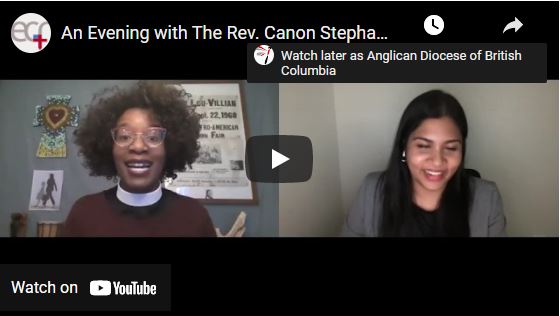
 The discussion centres around Canon Spellers’ latest book –
|
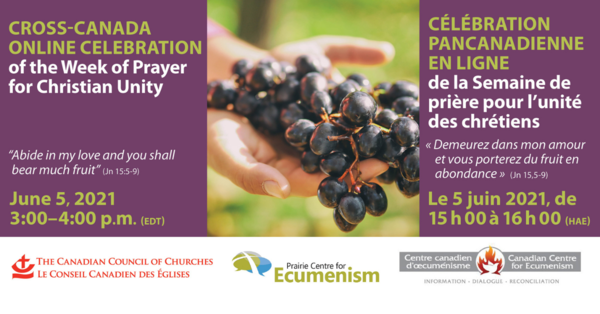
Week of Prayer for Christian Unity CelebrationDuring this season of Pentecost, The Canadian Council of Churches and its ecumenical partners, The Canadian Center for Ecumenism and The Prairie Center for Ecumenism, invite you to a cross-Canada online celebration of the Week of Prayer for Christian Unity. |
|
Mark your calendar: Investiture Service
|